
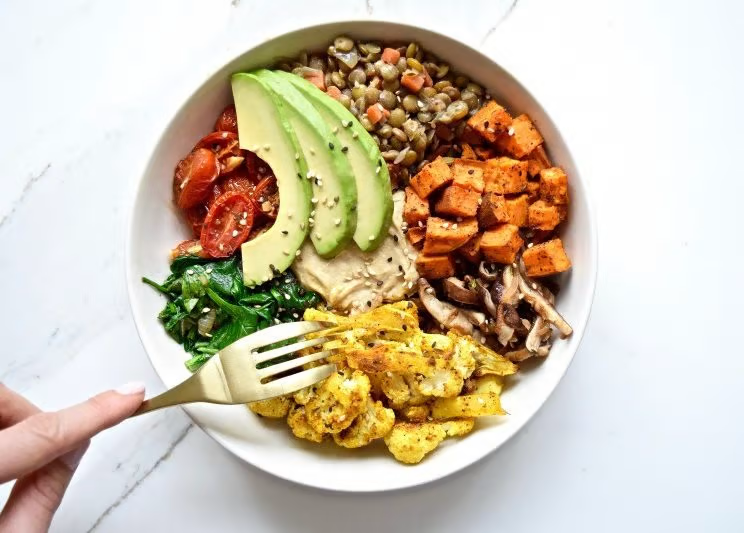
This week, my Harvard Medical School nutrition course took us deep into the heart of healthy eating, presenting the widely respected Harvard Healthy Eating Plate. (You can check it out here). It’s a visually appealing and, in theory, straightforward guide emphasizing whole grains, fruits and veggies, quality protein, and olive oil.
However, as anyone who’s ever tried to have a calm conversation about diet knows, things quickly get complicated. The live Q&A session that followed was a perfect illustration. Within minutes, the virtual room was buzzing with questions and concerns, a testament to the deeply personal and often confusing nature of nutrition.
“Eat grains? What about the GLUTEN?! I’ll DIE!”
“Why can’t I eat eggs? Aren’t they the perfect protein?”
“Saturated fat is good for you! It cures heart disease!”
“Is dairy inflammatory?”
“Will soy give me man-boobs?”
“Fruit? Too much sugar!”
The professor, bless her heart, valiantly tried to defend the evidence-based approach of the Healthy Eating Plate. But the sheer volume of conflicting opinions and personal experiences made it clear: nutrition is anything but simple.
And that’s where I believe the problem lies. While the Healthy Eating Plate offers a solid foundation, it assumes a level of uniformity that simply doesn’t exist. Ethnic backgrounds, individual biology, food allergies, gender, health status, and age all play significant roles in how our bodies process and utilize food.
So, how do we cut through the noise and find a healthy eating strategy that works for us? I propose a shift in focus, moving away from rigid guidelines and towards a more flexible, personalized approach.
Let’s start by looking at what all validated healthy eating strategies have in common:
EXCLUSIONS:
- Added Sugars: These are a universal enemy, contributing to a host of health problems.
- Highly Processed Foods: These lack essential nutrients and are often loaded with unhealthy additives.
- Trans-Fats: These are unequivocally bad for your heart health.
INCLUSIONS:
- Vegetables and Fruit: These are the cornerstones of a healthy diet, providing essential vitamins, minerals, and fiber.
Instead of getting bogged down in the minutiae of specific food groups, why not focus on these four core principles? Eliminate the bad, embrace the good, and then fill in the gaps with the natural, whole foods that work best for your individual needs.
Some people thrive on whole grains, while others experience digestive issues. Some prefer a protein-rich diet, while others lean towards plant-based options. And while olive oil might be a staple for some, others might prefer avocado or coconut oil.
Dr. Calley Means, in her insightful book “Good Energy,” eloquently explains this seeming contradiction: “It is important to realize that the body is remarkably capable of getting to similar outcomes with different inputs through redundant mechanisms…that is, you could be eating a sustainably sourced, unprocessed plant-based diet or an animal-based diet and still get the same molecular information for your cell.”
In essence, our bodies are incredibly adaptable. By focusing on the fundamentals—eliminating processed junk and embracing whole, natural foods—we can create a personalized eating strategy that supports our health and well-being, regardless of our individual preferences.
So, my advice is simple:
- Prioritize whole, unprocessed foods.
- Minimize added sugars, highly processed foods, and trans-fats.
- Load up on fruits and vegetables.
- Listen to your body and find the foods that make you feel your best.
Forget the rigid rules and embrace a more intuitive, personalized approach to nutrition. Your body will thank you.
Make Today Your Best Day,
Ben
 Age Strong
Leave a comment